

How to Be a Futurist: Students Deploy AI Tools, Produce Podcasts and Write Book in SCET Course

While formally listed as ENGIN183/283, this course is affectionately known by a more descriptive title: “To Be a Futurist: How to Win (and Lose), AI and Healthcare Startups.”
The class comprises approximately 70 students from all walks of life, majors, cultures, and academic levels—including undergraduate, graduate, PhD, and exchange students. Together, students from science, liberal arts, and business backgrounds create case studies, form multidisciplinary teams, and brainstorm the next generation of startup ideas.
The course is anchored by three main deliverables:

1. The Podcast and Founder Interviews
This midterm is not a typical quiz. Instead, students are encouraged to step out of their comfort zones to interview a founder on camera. Some find these subjects within their school networks, while others seek them out from past jobs or even recruit extended family members.
This is the second installment of these interviews. The submitted 6-minute videos were so compelling that we launched a podcast to share this entrepreneurial wisdom beyond the classroom.

The Assignment Brief
To set the context for the series, students were given the following prompt:
Startup Success Secrets: SCET Students Interview Founders (Fall 2025 Podcast Series)
Find a company founder in your network (or recruit a new one) and ask them about their entrepreneurial journey. Edit the video to the required time, adding visuals, special effects, transitions, logos, music, or subtitles to make it compelling. Please publish the video on YouTube.
Questions and Format:
- Introduction: Introduce yourself as the interviewer/reporter.
- The Founder: Name, business, and role.
- Background: What factors led you to start your own venture?
- Value Proposition: What problem are you solving, and what is the solution?
- Differentiation: What is your competitive advantage?
- Strategy: What is your business model and go-to-market strategy?
- Success Factors: Top 1-2 factors that made the venture succeed.
- Lessons Learned: What would you tell young entrepreneurs if you could do it all over again?
- Hardships: What is the hardest thing about being an entrepreneur?
The Results The results can be seen in the Fall 2025 Podcast Series, featuring a diverse range of founders:
- Koy Strategy (from Siya): A media consultant business conducting product testing.
- Accruely (from Darlene): An AI-based accounting automation game-changer for corporations.
- Factory VFX (from Madelyn): A visual effects studio entrepreneur who worked on Ford v Ferrari and The Big Bang Theory.
- Recall.AI (from Marissa): An API for meeting recording back-ends, founded by a former Department of State employee.
- Riff (from Thy): A Y Combinator founder building AI tools for music creation.
- Pear VC (from Xianzhi): A backstory on venture capital and an argument for customer empathy.
- Strategic Vantage (from Vladimir): A marketing and PR agency founder focused on real estate finance.
- Invesho (from Chuxuan): An interview with Shryas, who pivoted from building satellites to building a matching platform for investors and founders.
- Consultancy (from Albert): A chat with Isil Tabag, helping students apply for international degree programs.
- HolyShred (from Sasicha): The founder behind a Bay Area fast-casual Thai chain.
- MetaWare (from George): An AI startup sponsored by Tsinghua University focused on teen mental health counseling.
- Dryft (from Maximillian): An AI Automation Agent for manufacturing. (The founder started selling leaves at five years old, so she knew she was destined to be an entrepreneur!)
These interviews represent an incredible diversity of perspectives, cultures, and enterprises. They go far beyond the “Silicon Valley bro” stereotype, demonstrating that the entrepreneurial spirit is alive in marketing, education, food service, and healthcare—most of it infused with the power and efficiency of artificial intelligence.
2. The “AI for Social Impact” Poster
Students formed multidisciplinary teams of 4–7 members and were coached to create pitches for AI and Social Impact startups.
The Project Brief: Mediating the Art of the Pitch
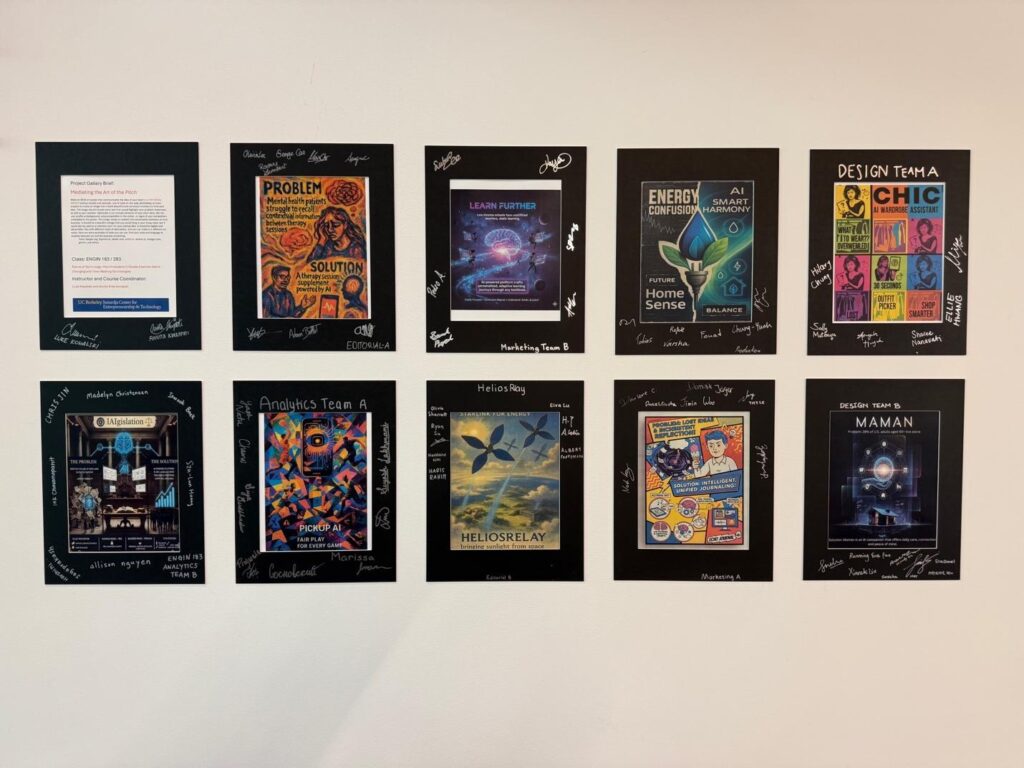
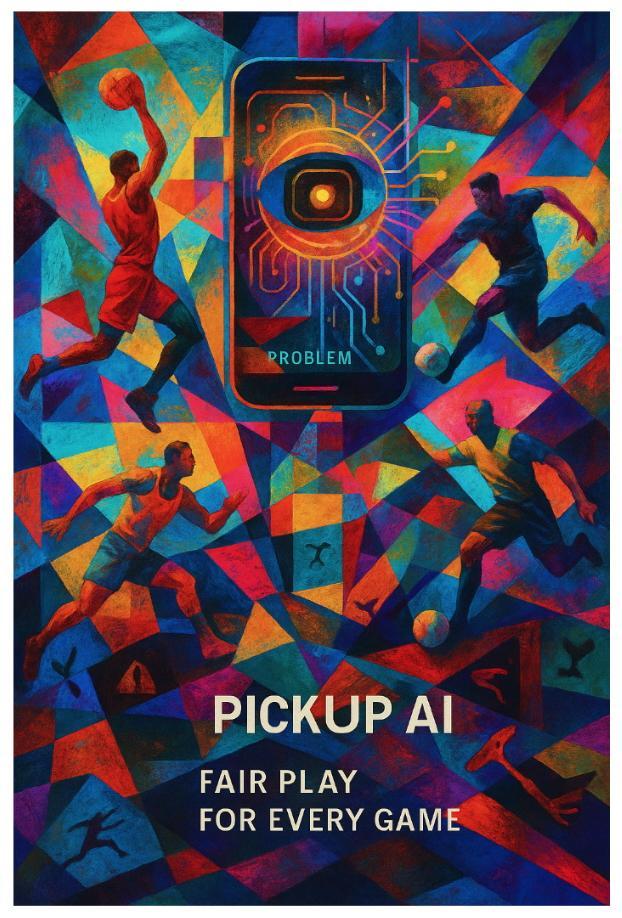
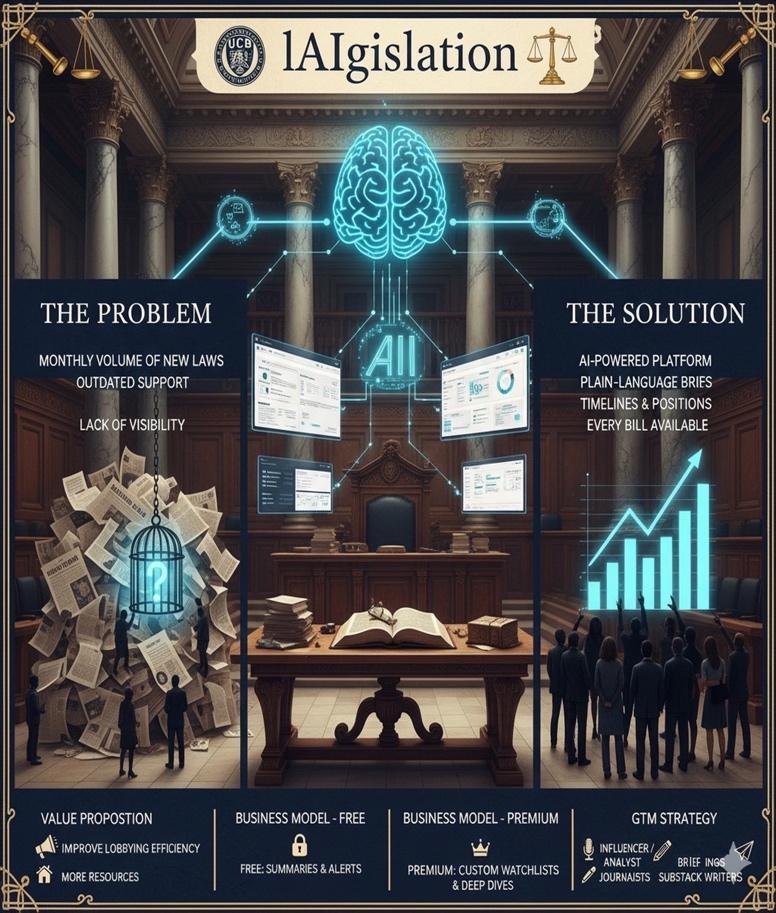
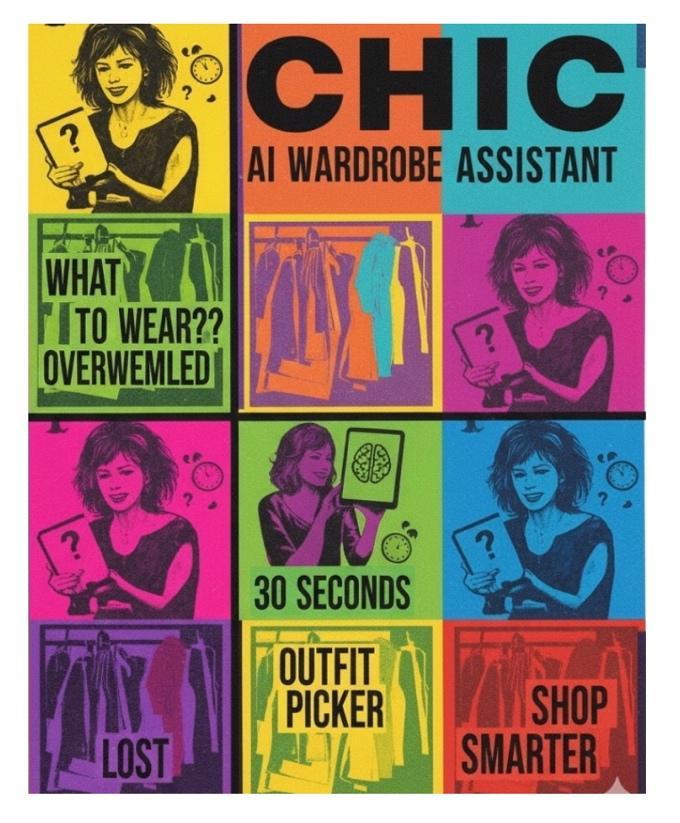
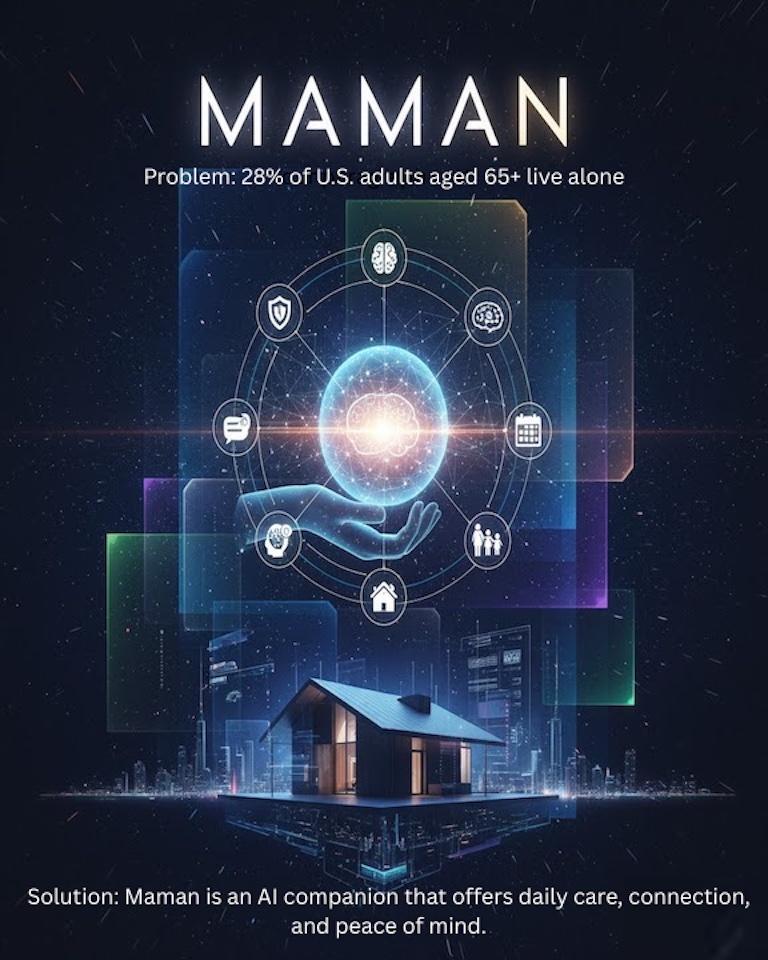
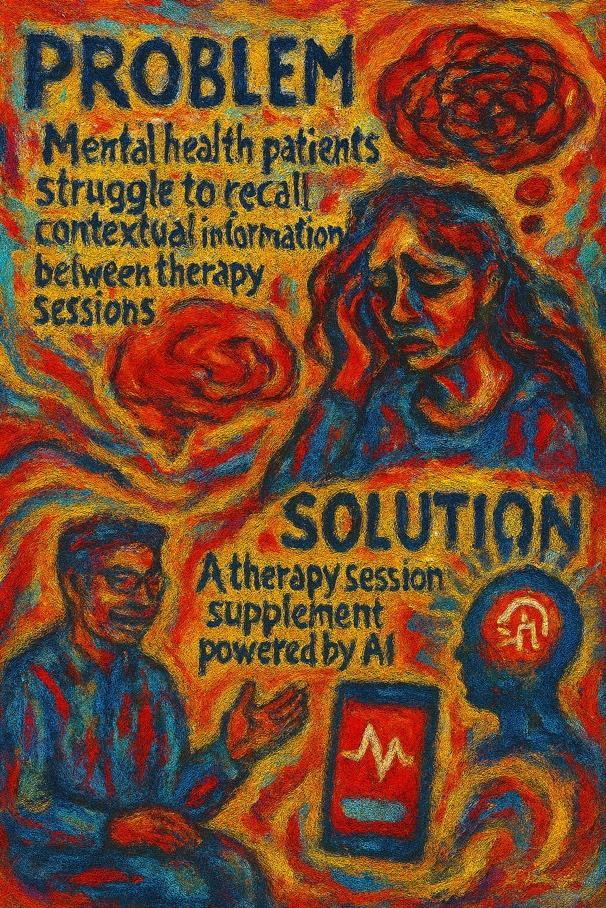
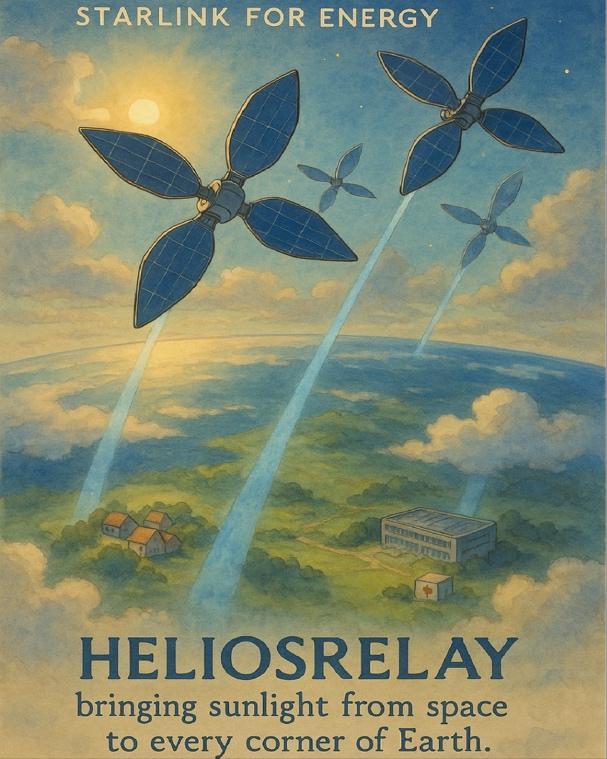
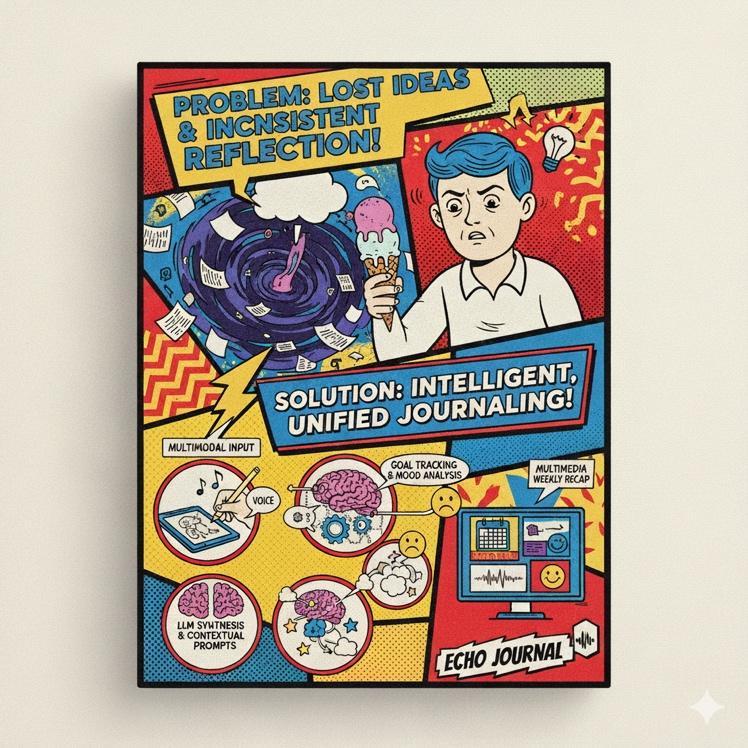
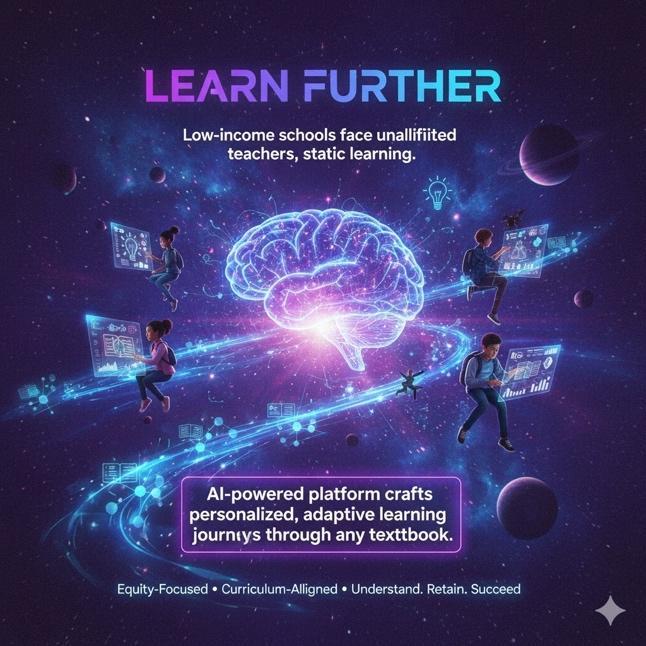
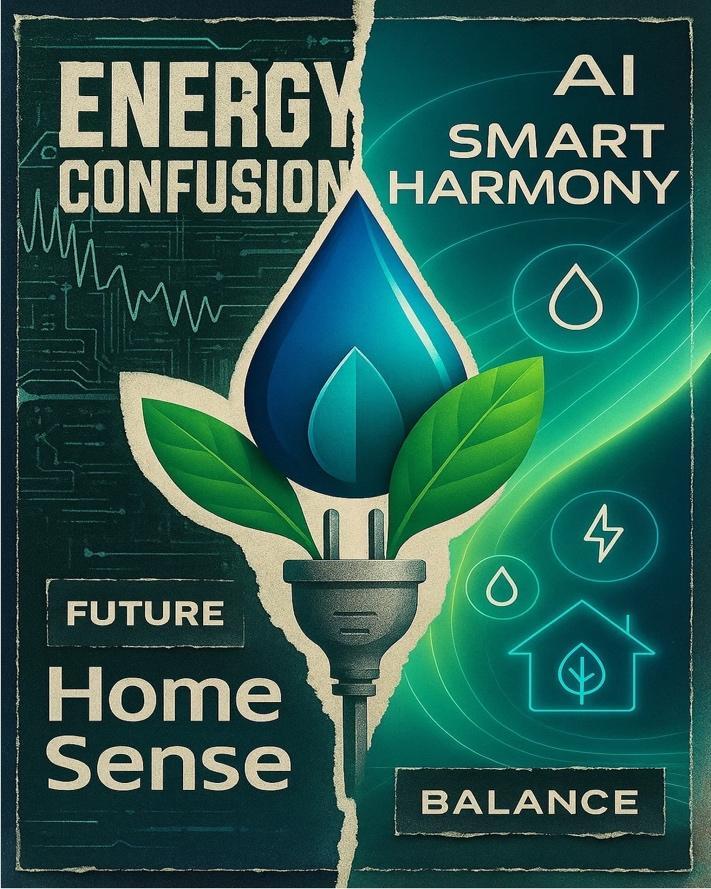
Each team must create three versions of an 8×10 art poster that communicates their startup idea both visually and textually.
Use AI tools (e.g., DeepAI, OpenArt, Midjourney, Gemini) or manual tools (Photoshop, crayons) to create an image that is aesthetically pleasing but also convinces investors to fund your idea. The image should include text highlighting the problem statement and the solution.
Goal: Mediate the conversation between art and business. It should be a beautiful collage suitable for a living room wall, but functional as an elevator pitch.
Example Prompt: Create a cubist-style collage based on a pitch deck for a startup helping professors create curricula from public textbooks. Include text about the lack of quality curricula and the AI solution. Include university logos.
Output of the student work and the Gallery
The Gallery The output of this student work, ranging from abstract to literal and cartoonish styles, is displayed in the AI for Social Impact Poster Gallery – Fall 2025.
3. The Futurist Book
The best way to describe the book created by the teams is to quote the Amazon Kindle description written by graduate student Rafael Sanlis:
“This book is a snapshot of what happens when curiosity, technology, and purpose meet inside a classroom at UC Berkeley. Created by the students of the Fall 2025 How to Be a Futurist course at the Sutardja Center for Entrepreneurship & Technology (SCET), it captures the mindset of a generation learning to shape the world rather than just inherit it.
The course was built around two innovation frontiers: Artificial Intelligence and Healthcare AI—domains where breakthroughs don’t just change industries; they change lives. Through research-based case studies, each student analyzed emerging ventures pushing these fields forward, using netnographic methods to go beyond headlines and uncover real ecosystems, incentives, and user behavior.
But entrepreneurship is not only analysis—it is human. To understand the lived experience behind innovation, each student also conducted a recorded interview with an entrepreneur, listening to unfiltered stories of risk, resilience, failure, and meaning. These conversations form the emotional backbone of the book, grounding theory in lived reality.
Working in teams, students then developed their own AI-for-social-impact startups. They built ‘Dirty Dozen’ pitch decks, designed business and revenue models, mapped technology architectures, and projected financials. But they also did something rare in business education: they translated those ideas into visual art. Through a poster collage exercise, they learned that every startup is also a narrative—and that how we feel a solution can be as important as how we explain it.”
Comparing consumer AI with healthcare AI revealed an essential lesson: technology advances fastest when it helps people understand themselves—their habits, bodies, impact, and potential. Whether optimizing home energy use or supporting clinicians with data-driven insights, the future is shaped by tools that empower humans rather than replace them.
This book is more than a compilation of research; it is a record of students learning to observe the world differently. It is a testament to creativity, rigor, collaboration, and the belief that the future is not something we wait for—it is something we build.
Books from this and past semesters are available for purchase on Amazon.
Contributors, Authors, and Student Teams
Analytics Teams
- Team A: Chenxi Qin, Marissa Jensen, Prajwala Maharjan, Ryugwang Jang, Siya Buddhadev, Suyash Lakhmani, Vladimir Sosnovskii, Yash Natu
- Team B: Allison Nguyen, Chris Jin, Harshini Jayaprakash, Ink Chavanapanit, Inwook Baek, Madelyn Christensen, Szu Lun Huang
Design Teams
- Team A: Angela Huynh, Austine Lotanna Iheji, Ellie Hwang, Hannah Park, Hilary Chung, Mia Wu, Sally Mutemwa, Shailee Nanavati
- Team B: Ella Donel, Mandy Liu, Melanie Wu, Runming Fan, Sasicha Thongkhaoaon, Sneha Menon, Xianzhi Liu
Editorial Teams
- Team A: Adam Bellet, Arturo Mendoza Gutierrez, George Cao, Maximilian Christof, Olivia Lee, Roxane Lambert, Sun-Q Kim, Yule Kim
- Team B: Albert Ponferrada Sicart, Alparslan Cetin, Elva Lu, Haris Rahim, Hongyi Yan, Madeleine Kim, Olivia Sharratt, Ryan Su
Marketing Teams
- Team A: Bi-Syuan Pan, Chuxuan Ma, Daniel Pasha, Darlene Chen, Dominik Jaeger, Jimin Woo, Noah Koenig, Thy Le
- Team B: Aljawharah Alrasheed, Ava Yu, Kaya Roberts, Pedro do Amaral, Sameh Phopal, Spencer Brien, Subin Lee
Production Team
- Chung-Yueh Wei, Fouad Sinno, Kevin Zhou, Rafael Sanlis, Rosa Guo, Sharon Zhao, Tobias Bangert, Varsha Chilukuri
The course will be offered again in the Spring of 2026, promising even more books, AI posters, and founder wisdom podcasts!
By Luke Kowalski, December / January 2026
While formally listed as ENGIN183/283, this course is affectionately known by a more descriptive title: “To Be a Futurist: How to Win (and Lose), AI and Healthcare Startups.”
The class comprises approximately 70 students from all walks of life, majors, cultures, and academic levels—including undergraduate, graduate, PhD, and exchange students. Together, students from science, liberal arts, and business backgrounds create case studies, form multidisciplinary teams, and brainstorm the next generation of startup ideas.
The course is anchored by three main deliverables:
1. The Podcast and Founder Interviews
This midterm is not a typical quiz. Instead, students are encouraged to step out of their comfort zones to interview a founder on camera. Some find these subjects within their school networks, while others seek them out from past jobs or even recruit extended family members.
This is the second installment of these interviews. The submitted 6-minute videos were so compelling that we launched a podcast to share this entrepreneurial wisdom beyond the classroom.
The Assignment Brief
To set the context for the series, students were given the following prompt:
Startup Success Secrets: SCET Students Interview Founders (Fall 2025 Podcast Series)
Find a company founder in your network (or recruit a new one) and ask them about their entrepreneurial journey. Edit the video to the required time, adding visuals, special effects, transitions, logos, music, or subtitles to make it compelling. Please publish the video on YouTube.
Questions and Format:
- Introduction: Introduce yourself as the interviewer/reporter.
- The Founder: Name, business, and role.
- Background: What factors led you to start your own venture?
- Value Proposition: What problem are you solving, and what is the solution?
- Differentiation: What is your competitive advantage?
- Strategy: What is your business model and go-to-market strategy?
- Success Factors: Top 1-2 factors that made the venture succeed.
- Lessons Learned: What would you tell young entrepreneurs if you could do it all over again?
- Hardships: What is the hardest thing about being an entrepreneur?
The Results The results can be seen in the Fall 2025 Podcast Series, featuring a diverse range of founders:
- Koy Strategy (from Siya): A media consultant business conducting product testing.
- Accruely (from Darlene): An AI-based accounting automation game-changer for corporations.
- Factory VFX (from Madelyn): A visual effects studio entrepreneur who worked on Ford v Ferrari and The Big Bang Theory.
- Recall.AI (from Marissa): An API for meeting recording back-ends, founded by a former Department of State employee.
- Riff (from Thy): A Y Combinator founder building AI tools for music creation.
- Pear VC (from Xianzhi): A backstory on venture capital and an argument for customer empathy.
- Strategic Vantage (from Vladimir): A marketing and PR agency founder focused on real estate finance.
- Invesho (from Chuxuan): An interview with Shryas, who pivoted from building satellites to building a matching platform for investors and founders.
- Consultancy (from Albert): A chat with Isil Tabag, helping students apply for international degree programs.
- HolyShred (from Sasicha): The founder behind a Bay Area fast-casual Thai chain.
- MetaWare (from George): An AI startup sponsored by Tsinghua University focused on teen mental health counseling.
- Dryft (from Maximillian): An AI Automation Agent for manufacturing. (The founder started selling leaves at five years old, so she knew she was destined to be an entrepreneur!)
These interviews represent an incredible diversity of perspectives, cultures, and enterprises. They go far beyond the “Silicon Valley bro” stereotype, demonstrating that the entrepreneurial spirit is alive in marketing, education, food service, and healthcare—most of it infused with the power and efficiency of artificial intelligence.
2. The “AI for Social Impact” Poster
Students formed multidisciplinary teams of 4–7 members and were coached to create pitches for AI and Social Impact startups.
The Project Brief: Mediating the Art of the Pitch
Each team must create three versions of an 8×10 art poster that communicates their startup idea both visually and textually.
Use AI tools (e.g., DeepAI, OpenArt, Midjourney, Gemini) or manual tools (Photoshop, crayons) to create an image that is aesthetically pleasing but also convinces investors to fund your idea. The image should include text highlighting the problem statement and the solution.
Goal: Mediate the conversation between art and business. It should be a beautiful collage suitable for a living room wall, but functional as an elevator pitch.
Example Prompt: Create a cubist-style collage based on a pitch deck for a startup helping professors create curricula from public textbooks. Include text about the lack of quality curricula and the AI solution. Include university logos.
Output of the student work and the Gallery
The Gallery The output of this student work, ranging from abstract to literal and cartoonish styles, is displayed in the AI for Social Impact Poster Gallery – Fall 2025.
3. The Futurist Book
The best way to describe the book created by the teams is to quote the Amazon Kindle description written by graduate student Rafael Sanlis:
“This book is a snapshot of what happens when curiosity, technology, and purpose meet inside a classroom at UC Berkeley. Created by the students of the Fall 2025 How to Be a Futurist course at the Sutardja Center for Entrepreneurship & Technology (SCET), it captures the mindset of a generation learning to shape the world rather than just inherit it.
The course was built around two innovation frontiers: Artificial Intelligence and Healthcare AI—domains where breakthroughs don’t just change industries; they change lives. Through research-based case studies, each student analyzed emerging ventures pushing these fields forward, using netnographic methods to go beyond headlines and uncover real ecosystems, incentives, and user behavior.
But entrepreneurship is not only analysis—it is human. To understand the lived experience behind innovation, each student also conducted a recorded interview with an entrepreneur, listening to unfiltered stories of risk, resilience, failure, and meaning. These conversations form the emotional backbone of the book, grounding theory in lived reality.
Working in teams, students then developed their own AI-for-social-impact startups. They built ‘Dirty Dozen’ pitch decks, designed business and revenue models, mapped technology architectures, and projected financials. But they also did something rare in business education: they translated those ideas into visual art. Through a poster collage exercise, they learned that every startup is also a narrative—and that how we feel a solution can be as important as how we explain it.”
Comparing consumer AI with healthcare AI revealed an essential lesson: technology advances fastest when it helps people understand themselves—their habits, bodies, impact, and potential. Whether optimizing home energy use or supporting clinicians with data-driven insights, the future is shaped by tools that empower humans rather than replace them.
This book is more than a compilation of research; it is a record of students learning to observe the world differently. It is a testament to creativity, rigor, collaboration, and the belief that the future is not something we wait for—it is something we build.
Books from this and past semesters are available for purchase on Amazon.
Contributors, Authors, and Student Teams
Analytics Teams
- Team A: Chenxi Qin, Marissa Jensen, Prajwala Maharjan, Ryugwang Jang, Siya Buddhadev, Suyash Lakhmani, Vladimir Sosnovskii, Yash Natu
- Team B: Allison Nguyen, Chris Jin, Harshini Jayaprakash, Ink Chavanapanit, Inwook Baek, Madelyn Christensen, Szu Lun Huang
Design Teams
- Team A: Angela Huynh, Austine Lotanna Iheji, Ellie Hwang, Hannah Park, Hilary Chung, Mia Wu, Sally Mutemwa, Shailee Nanavati
- Team B: Ella Donel, Mandy Liu, Melanie Wu, Runming Fan, Sasicha Thongkhaoaon, Sneha Menon, Xianzhi Liu
Editorial Teams
- Team A: Adam Bellet, Arturo Mendoza Gutierrez, George Cao, Maximilian Christof, Olivia Lee, Roxane Lambert, Sun-Q Kim, Yule Kim
- Team B: Albert Ponferrada Sicart, Alparslan Cetin, Elva Lu, Haris Rahim, Hongyi Yan, Madeleine Kim, Olivia Sharratt, Ryan Su
Marketing Teams
- Team A: Bi-Syuan Pan, Chuxuan Ma, Daniel Pasha, Darlene Chen, Dominik Jaeger, Jimin Woo, Noah Koenig, Thy Le
- Team B: Aljawharah Alrasheed, Ava Yu, Kaya Roberts, Pedro do Amaral, Sameh Phopal, Spencer Brien, Subin Lee
Production Team
- Chung-Yueh Wei, Fouad Sinno, Kevin Zhou, Rafael Sanlis, Rosa Guo, Sharon Zhao, Tobias Bangert, Varsha Chilukuri
The course will be offered again in the Spring of 2026, promising even more books, AI posters, and founder wisdom podcasts!
By Luke Kowalski, December / January 2026